



Drovers roads, living pathways
“Las cañadas” or drovers roads are paths which have traditionally been used for travel by herds of livestock. These are not mere trails, however: drovers roads are ecological highways that protect biodiversity and help combat climate change.
‘Trashumancia y Naturaleza’ stands with the shepherds that fight to preserve this way of life on the Iberian Peninsula.
By supporting us, you help maintain tradition as a means of ensuring our future.
The arteries of biodiversity
You’ve probably taken a walk down more than a one drovers road and you didn’t even know it! Stepping upon the very asphalt of Madrid means to traverse ancient pathways upon which livestock have travelled, as one of the main drovers road of the peninsula passes right through the centre of the capital city.
Drovers roads have become duly recognised as Intangible Cultural Heritage, covering a total distance of 125,000 kilometres and spanning 420,000 hectares. This is, even on a global scale, unique. This circulation of thousands of herds of livestock has sculpted our landscape and collective memory for generations, the lilting rhythm of their cowbells carried upon the breeze.
But, why are they so important? Well, they…
- Preserve biodiversity thanks to the livestock’s seed dispersal and connecting of ecosystems.
- Mitigate climate change as the grazing of livestock creates carbon sinks and prevents wildfires.
- Offer a sustainable model of food production.
- Renew cultural traditions and ancient natural knowledge.
For this reason, ‘Trashumancia y Naturaleza’
demands an increased recognition of the value of drovers roads;
the native breeds that traverse them
and the shepherds and their families that keep them alive
TRANSHUMANCE SEEN IN NUMBERS

In Spain, each transhumant sheep disseminates around 5.000 seeds every day and fertilises the land with over 3 kilos of manure

The sustainable management of pastures through grazing and other appropriate agricultural practices can fix between 10 and 20% of global CO2 emissions, actively combating climate change

Transhumance nourishes Iberian biodiversity, which includes over 220 native species of livestock, 750 different varieties of crops and around 80,000 species of wildlife

Reviving transhumant practices would create 5,000 jobs in the rural economy, and in turn generate job opportunities related to the commercialisation of its products, tourism and environmental services
Transhumance on the Iberian Peninsula: A unique case in Europe that must be protected
At the moment, in Europe, there exist only two regions in which the mass movement of livestock over long distances still takes place: the transhumance of reindeer in Scandinavia and our own, here in Spain.
The intensive rearing and on-farm models have relegated transhumance to anecdotal status in countries such as Italy or Greece. The Iberian Peninsula is a unique case as it is the only one in Europe that harbours a network of drovers roads harking all the way back to the XIII century.
However, a significant number of its routes suffer from severe neglect due to the lack of resting and watering points, needed every 5 or 6 kilometers. Without these, transhumant practice seems set to disappear.
Our organisation works to improve the state of drovers roads since 1997, proving that is is possible to revive this form of shepherding if the right logistical and economic conditions are met to dignify this profession.
We defend that transhumance is key
to the survival of our Iberian Peninsula’s ecosystems.
We advocate for the role of shepherding as a tool of alternative
environmental management for a thriving rural world
while maintaining a culture of transhumance that has existed
for thousands of years.
We are an organisation that pioneers promoting the transhumant lifestyle as a tool to combat climate change and as an ally for biodiversity.
And we lead by example, walking with our herd.
From 1993 through 2020 we have walked 122,930 km of drovers roads alongside transhumant families
Sheep
4000000
Goats
10000
Horses
300
Cows
20000
We journey beside 52 transhumant families from all over the peninsula
On their journey, our flocks have dispersed…

128 billion of seeds

77 thousand tonnes
of manure
Transhumance = life
CONTACT US
For more information on transhumance and nature, take a look at our blog

La Fundación alega el Anteproyecto de Ley que quiere rebajar la protección de las Vías Pecuarias en Madrid.
2 de February de 2026
La Fundación rechaza el Anteproyecto de Ley de medidas urgentes para el incremento de la Oferta de Viviendas, ya que reforma a Ley de Vías

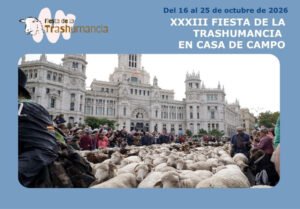
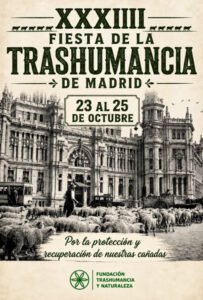
Fiesta de la Trashumancia – Madrid 2025
9 de January de 2026
Un año mas la Fundación Trashumancia y Naturaleza ha podido organizar el paso de la Trashumancia por el centro de Madrid. El rebaño llegó a